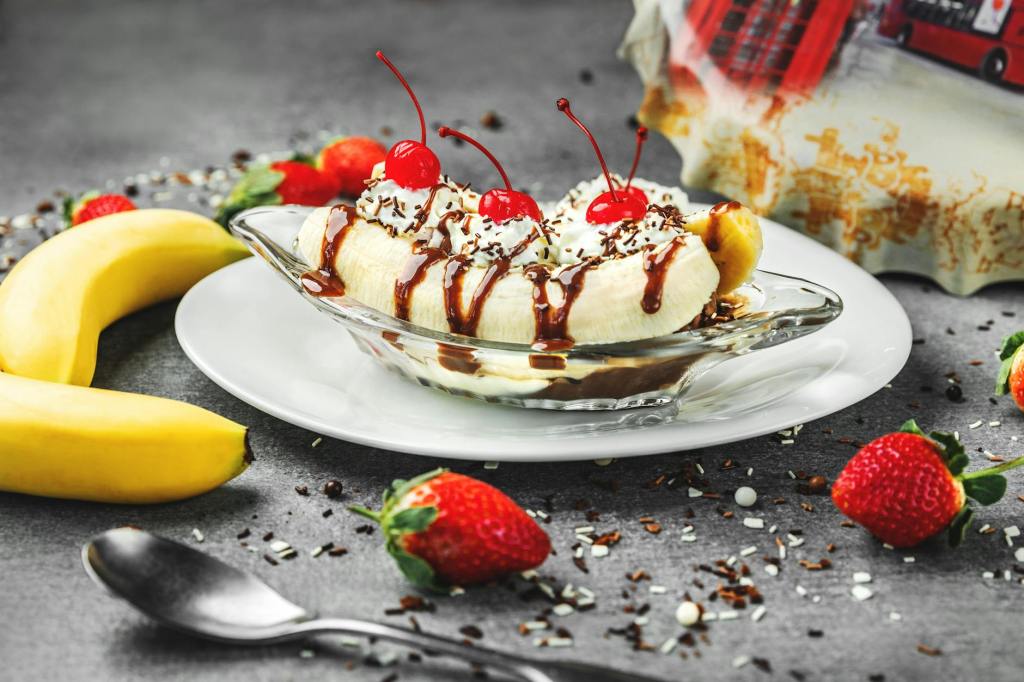
It’s Aug. 25 — National Banana Split Day!
The banana split is a beloved American dessert that has delighted sweet tooths for over a century. This iconic treat, consisting of a banana split lengthwise and topped with scoops of ice cream, syrup, whipped cream, nuts and a cherry, has a rich history rooted in innovation and friendly competition.
The origin of the banana split dates back to 1904 in Latrobe, Pennsylvania. A young pharmacist named David Strickler, working at Tassell Pharmacy’s soda fountain, is credited with inventing the dessert. Inspired by the growing popularity of ice cream sundaes, Strickler sought to create something more extravagant to attract students from nearby Saint Vincent College.
He sliced a banana in half, placed it in a long dish, and added three scoops of ice cream — vanilla, chocolate, and strawberry — each topped with its own syrup: chocolate, pineapple and strawberry. To finish, he added whipped cream, chopped nuts and a cherry. The banana split was sold for ten cents, double the price of a regular sundae, but it quickly became a hit.
Strickler’s creation didn’t remain a local phenomenon for long. The banana split’s popularity spread throughout the country, especially after being featured at soda fountains in major cities. Rival claims to the dessert’s invention emerged, most notably from Wilmington, Ohio, where a restaurant owner named Ernest Hazard allegedly concocted his version in 1907 as part of a contest.
Despite competing claims, Latrobe is widely recognized as the birthplace of the banana split, and the town celebrates this legacy with an annual Banana Split Festival.
Today, the banana split remains a symbol of American dessert culture, embodying the creativity and indulgence of the early 20th-century soda fountain era. Whether enjoyed in its classic form or with modern twists, the banana split continues to be a favorite treat for all ages.




 It's Christmas 365